Studio FacileMade Visual
AP Psychology · Intro Psych · US edition

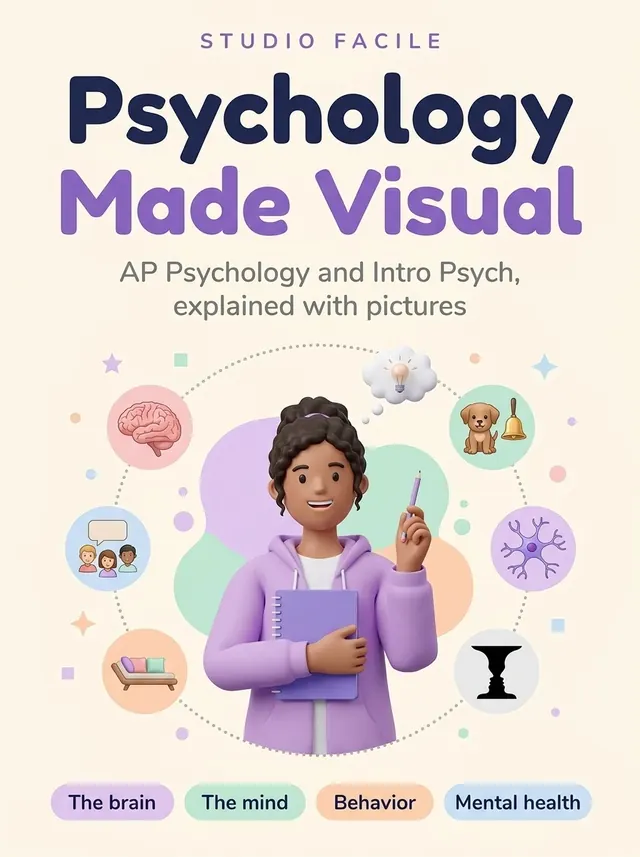
Psychology Made Visual

Neurons, memory, Piaget and Milgram, explained with pictures.

80 illustrated pages, one idea per page, following the five units of AP Psychology. Plus two free bonuses: a 150-question practice test with every answer explained, and a research methods and stats cheat sheet.
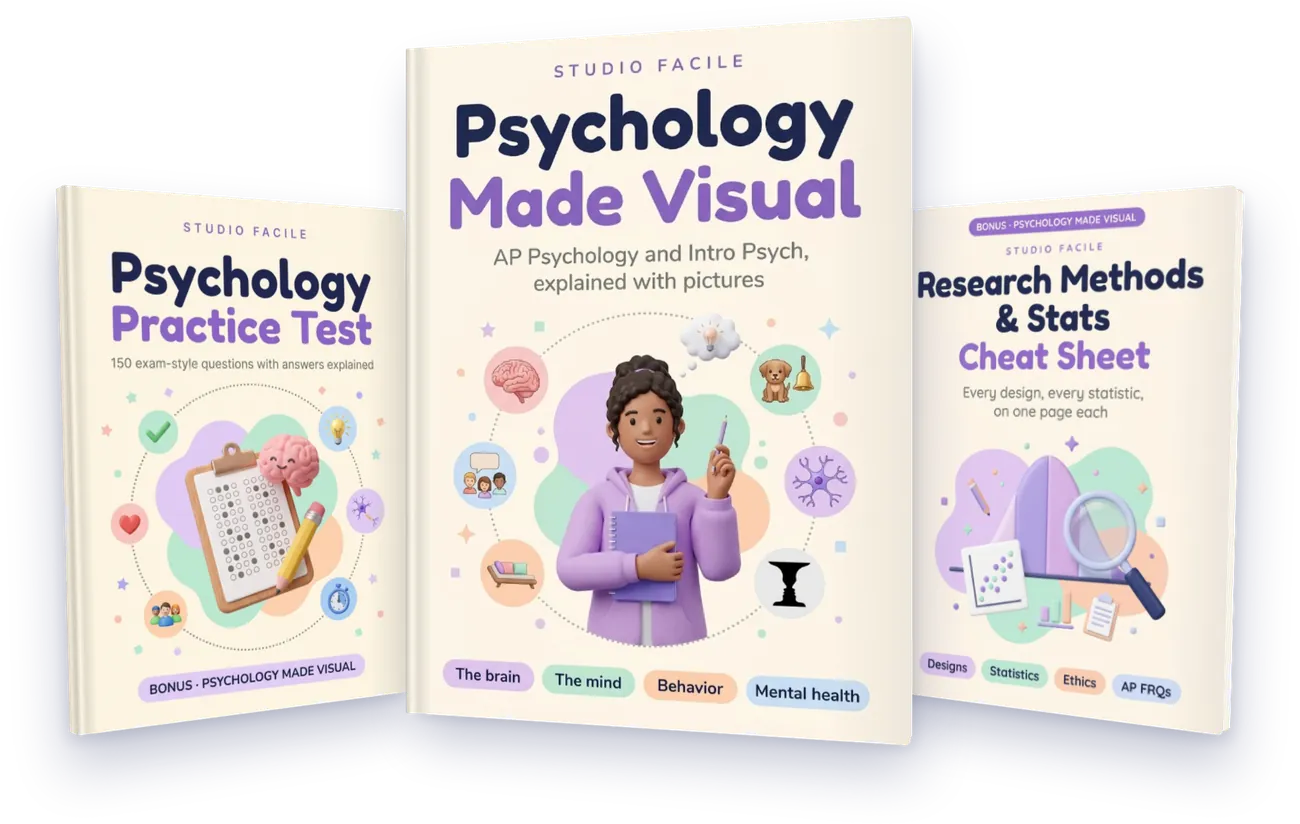
The three books: Psychology Made Visual, Psychology Practice Test and Research Methods & Stats Cheat Sheet
  • One idea per pageLook at the drawing first, then read the boxes.
  • Built on the five AP unitsPlus research methods, with questions on data in every unit.
  • Three PDFs by emailRead them on your phone, print what you need.
Get the 3 books — $27
Secure checkout Instant download 30-day refund policy
80illustrated pages,
one idea each
150practice questions,
answers explained
3PDFs: the book
+ 2 free bonuses
Look inside

This Is What a Page Actually Looks Like

Real pages from the three books. Tap any page to see it full size.

How the book works

One Page, One Idea

Every page is built the same way, so you always know where to look.

1

Look at the drawing

The picture carries the idea: the neuron firing, the stages, the experiment.

Every page
2

Read the boxes

Each box gives one fact, one term or one study, in plain words.

Every page
3

Check the dark strip

The point students most often miss on the exam, at the bottom of the page.

Every page
How each page worksThe label at the top left gives the AP topic. The drawing carries the idea, the boxes give the facts, and the dark strip at the bottom holds the point most often missed on the exam.
The difference

A Textbook Chapter vs. A Page You Understand

Thirty pages of text and bold terms

  • Terms in bold with no picture of what they mean
  • Studies, names and dates you have to memorize in a list
  • Similar ideas that blur together on the test
  • No clear idea of what the exam actually asks

Psychology Made Visual

  • Every idea drawn: the neuron, the brain, the stages, the experiment
  • Each study in a box: what they did and what they found
  • A last-minute page on the pairs students mix up
  • Built on the five AP units, with research methods in every one
The kit

One Book to Learn It. Two to Lock It In.

The book teaches. The practice test shows you what to review. The cheat sheet keeps research methods and stats on a few pages. The two bonuses are free.

The bookPsychology Made Visual80 pages · 6 parts

Psychology Made Visual

Psychology as a science, the biological bases of behavior, cognition, development and learning, social psychology and personality, and mental and physical health. One idea per page.

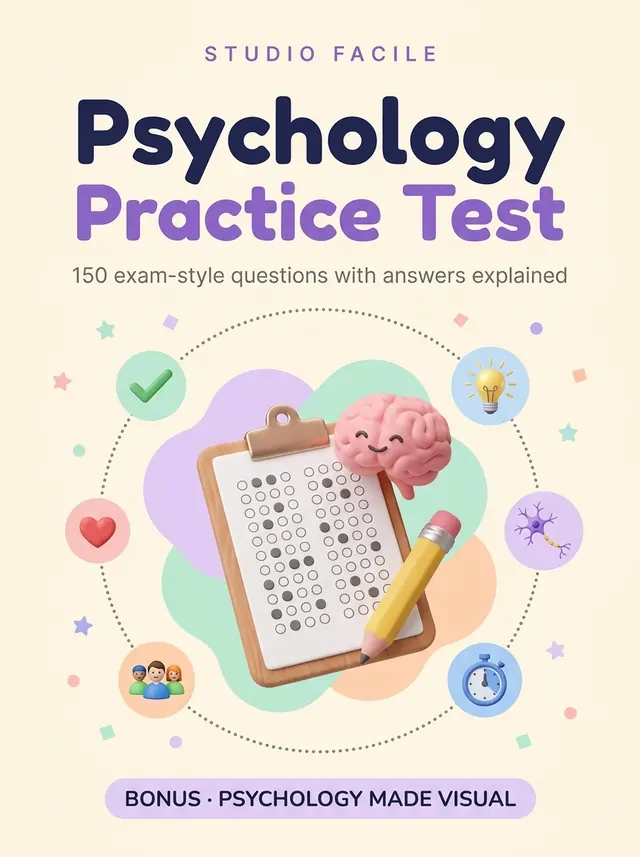
Bonus 1 · FreePsychology Practice Test24 pages · 150 questions

Psychology Practice Test

150 exam-style questions in five blocks of 30, one per AP unit, with research and data questions in every block. An answer sheet to print and an answer key with one line on why, plus what to review if you missed it.

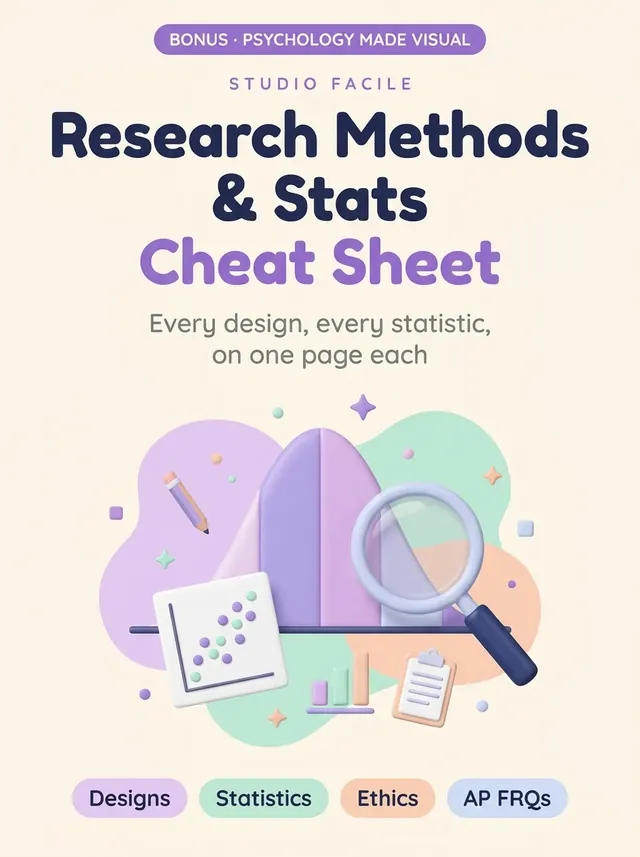
Bonus 2 · FreeResearch Methods & Stats Cheat Sheet21 pages · made to keep

Research Methods & Stats Cheat Sheet

Variables and designs, samples and controls, describing data (mean, standard deviation, the normal curve, z-scores, correlation), significance and ethics, with worked examples, and how to approach the two free-response questions.

Get the kit — $27
What is inside the book

Six Parts, From the Neuron to Therapy

The real table of contents. Tap a part to see its pages.

IPart I · pp. 4–13Psychology as a ScienceHow psychologists know what they know
  1. Seven perspectives, one behavior
  2. Why common sense is not enough
  3. Case studies, surveys and observation
  4. Correlation is not causation
  5. The experiment
  6. Samples, placebos and blind studies
  7. Describing data: center and spread
  8. The normal curve and what results mean
  9. Research ethics
IIPart II · pp. 14–29Biological Bases of BehaviorGenes, neurons, the brain, sleep and the senses
  1. Nature and nurture
  2. The nervous system at a glance
  3. The neuron
  4. How a neuron fires
  5. Neurotransmitters and hormones
  6. Drugs and the synapse
  7. From the brainstem to the limbic system
  8. The four lobes of the cortex
  9. Two hemispheres and a changing brain
  10. Sleep stages and body clocks
  11. Why we sleep, why we dream
  12. Sensation: thresholds and adaptation
  13. Vision
  14. Hearing
  15. Smell, taste, touch and balance
IIIPart III · pp. 30–41CognitionPerception, thinking, memory and intelligence
  1. Perception: bottom-up and top-down
  2. Organizing what we see
  3. Concepts, schemas and shortcuts
  4. Decision traps and creativity
  5. Kinds of memory
  6. Three models of memory
  7. Encoding: getting it in
  8. Storing and retrieving
  9. Forgetting and false memories
  10. Intelligence: theories and tests
  11. Intelligence scores in context
IVPart IV · pp. 42–55Development and LearningHow we grow and how we learn
  1. Themes and methods of development
  2. Growing bodies, from before birth to old age
  3. Piaget's four stages
  4. Vygotsky and the aging mind
  5. Language
  6. Attachment and parenting
  7. Erikson's eight stages
  8. Adolescence and identity
  9. Classical conditioning
  10. Fear, taste aversion and habituation
  11. Operant conditioning
  12. Shaping and schedules of reinforcement
  13. Learning by watching and thinking
VPart V · pp. 56–67Social Psychology and PersonalityOther people, the self, motivation and emotion
  1. Explaining behavior: attributions
  2. Stereotypes, prejudice and expectations
  3. Changing minds: dissonance and persuasion
  4. Conformity and obedience
  5. What groups do to us
  6. Helping, conflict and cooperation
  7. The psychodynamic view
  8. The humanistic and social-cognitive views
  9. Traits and the Big Five
  10. Motivation
  11. Emotion
VIPart VI · pp. 68–80Mental and Physical HealthStress, well-being, disorders and treatment
  1. Stress and the body
  2. Coping and positive psychology
  3. What makes a disorder
  4. Neurodevelopmental and schizophrenia spectrum disorders
  5. Depressive and bipolar disorders
  6. Anxiety disorders
  7. OCD, trauma and dissociation
  8. Eating and personality disorders
  9. Talk therapies
  10. Behavior therapies, groups and hypnosis
  11. Medication, brain stimulation and care today
  12. Last-minute review: pairs students mix up
For the exam

It Follows the Five Units of AP Psychology

The book is organized around the AP Psychology course framework (2024), and the practice test gives each unit a block of 30 questions, with research and data questions in every block:

AP PsychologyIntro PsychResearch methods
1
Biological Bases of BehaviorQuestions 1–30
2
CognitionQuestions 31–60
3
Development and LearningQuestions 61–90
4
Social Psychology and PersonalityQuestions 91–120
5
Mental and Physical HealthQuestions 121–150

AP is a registered trademark of the College Board, which is not affiliated with, and does not endorse, this product. The 150 questions were written for this book: they are not official or released AP exam questions. The real exam sets its own scoring, so check the College Board exam page.

How you use it

Read It, Keep It Close, Test Yourself

1

Read one part at a time

Six parts, in the order of the course: the science, the brain, cognition, development and learning, social psychology, and health.

2

Keep the cheat sheet close

Research methods and stats show up in every unit. The cheat sheet keeps the designs, the numbers and the traps on a few pages.

3

Take the test one block a day

30 questions per block. Aim for at least 24 of 30; the key sends every wrong answer back to its pages in the book.

Is this for you

Who This Was Drawn For

You are taking AP Psychology

Five units and a lot of terms. Each idea on one illustrated page you can come back to before the exam.

You are in Intro to Psychology

The same core topics as a college intro course: the brain, memory, development, social psychology and disorders.

Your exam is coming up

150 practice questions in five blocks and a last-minute page on the pairs students mix up.

The offer

Everything You Get, For One Payment

Psychology Made Visual · the kit

The three books
  • ✓The book: 80 illustrated pages, six parts
  • ✓Bonus 1: Psychology Practice Test, 150 questions Free
  • ✓Bonus 2: Research Methods & Stats Cheat Sheet Free
  • ✓Answer sheet to print, every answer explained Included
  • ✓Print it as often as you want Included
One payment$27No subscription
Get the kit — $27
Secure checkout Instant download 30-day refund policy
The PDFs are emailed to you right after checkout.

30
days

If something is wrong with it, you get your money back

For 30 days. If a file does not open, if what you received is not what this page describes, if you were charged twice or the download never arrived, write to us and we refund you in full.

One email to info@studiofacilebook.com is enough.

Questions

Before You Decide

Is this official AP material?

No. It is an independent illustrated study guide. It follows the five units of the AP Psychology course framework, but AP is a registered trademark of the College Board, which is not affiliated with and does not endorse this product. The 150 practice questions were written for this book; they are not official exam questions.

Does it replace my textbook or my class?

No. It is the illustrated material that goes with your course: one idea per page, to understand it and review it. Your teacher and your syllabus come first.

Is it only for AP students?

No. The topics are the core of a college Intro to Psychology course too. A few college topics outside the AP framework are not covered in depth.

How do I get it?

By email, straight after you buy. Three PDFs you can read on your phone, tablet or computer.

Can I print it?

Yes, as many times as you want, for yourself. The practice test has an answer sheet to print and fill in.

How many pages is it?

The book has 80 pages, the Practice Test 24 and the Cheat Sheet 21.

Is it a subscription?

No. One payment of $27, and the three PDFs are yours.

One Last Thing

Psychology is easier to remember when you have seen it. The book draws each idea, so you can picture it on the exam instead of trying to recall a paragraph.

See it.
Understand it.
Remember it.

Get the 3 books — $27
All three PDFs by email